
Strategic Legal Due Diligence in M&A: Aligning Buyer Motivation with Transaction Success

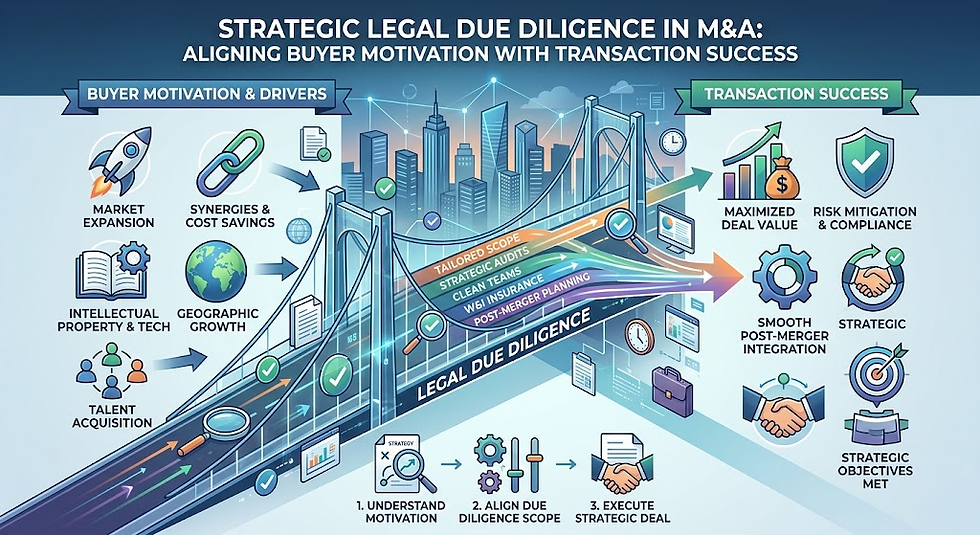
Strategic Legal Due Diligence in M&A: Aligning Buyer Motivation with Transaction Success
Legal due diligence in M&A is far more than a standard risk-check exercise—it is a value-driver. Traditional due diligence focuses primarily on discovering liabilities, but a strategic approach aligns the investigation with the buyer’s underlying motivations. Whether the goal is acquiring intellectual property, entering new markets, or consolidating operations, understanding the drivers behind the transaction dictates the scope, negotiation tactics, and post-closing integration.
1. Executive Summary & Core Takeaways
Strategic Alignment Directs Scope: Broad, generic due diligence wastes time and budget. Scoping must reflect the acquirer’s deal drivers—such as IP assets, customer bases, or tech stacks.
Risk Tolerance Shapes Terms: A buyer’s appetite for risk determines whether identified red flags result in purchase price adjustments, representations and warranties, clean teams, or Warranty & Indemnity (W&I) insurance.
Negotiation Leverage: Knowing why you are buying allows legal teams to structure bulletproof contractual protections around core value drivers.
Early Integration Planning: Post-merger integration (PMI) risks, including Transitional Service Agreements (TSAs) and regulatory hurdles, must be evaluated during due diligence—not after signing.
2. Key M&A Drivers & Corresponding Due Diligence Focus Areas
Strategic Buyer Motivation | Primary Due Diligence Focus Areas | Essential Legal & Operational Mechanisms |
Intellectual Property & Technology | Patent validity, trademark ownership, open-source code compliance, R&D agreements | Technical due diligence, IP litigation audit, non-compete clauses |
Market Expansion & Customer Access | Key customer/supplier contracts, change-of-control clauses, antitrust laws | Commercial due diligence, competition law review, Clean Team Agreements |
Geographic Growth | Local regulatory compliance, foreign investment laws (FDI), cross-border tax | Local legal counsel engagement, export control audit |
Talent & Human Capital | Employment contracts, executive retention, labor union relations, pension liabilities | Retention agreements, key-person insurance, HR integration assessment |
3. Aligning Legal Due Diligence with Strategic Objectives
To maximize deal value, legal advisors must tailor the scope of due diligence to match the acquirer’s strategic thesis.
IP and Tech-Driven Acquisitions
When the target’s value lies in technology or proprietary assets:
Prioritize patent portfolios, trademark protections, and trade secret safeguards.
Conduct joint technical and legal reviews to assess software licensing and cybersecurity vulnerabilities.
Mitigate litigation risks related to third-party IP infringement.
Market Share and Competitor Acquisitions
When acquiring a direct competitor or expanding market presence:
Competition Law & Clean Teams: Sharing sensitive commercial data with a competitor creates significant legal risks under antitrust and competition regulations. Implementing a Clean Team—an independent group of advisors restricted from sharing sensitive data with the buyer's operational team—allows thorough review without breaching gun-jumping regulations.
Audit top customer and supplier contracts for "Change of Control" clauses that could permit termination upon acquisition.
Risk Tolerance and Transaction Structures
A buyer's risk profile shapes how deal terms are negotiated:
High Risk Appetite: May accept known red flags in exchange for purchase price discounts, specific indemnities, or earn-out structures.
Risk-Averse Acquirers: Utilize Warranty & Indemnity (W&I) Insurance to shift liability to insurers. This is particularly advantageous when sellers remain as key management post-closing, preserving positive ongoing working relationships.
4. Enhancing Negotiation Leverage and Deal Structuring
Understanding transaction drivers directly impacts transaction structuring and contractual leverage:
Asset Purchase vs. Share Purchase: If the buyer seeks specific divisions or technologies rather than the whole entity, an asset deal or pre-closing carve-out minimizes liability exposure.
Bilateral vs. Auction Dynamics: In a competitive auction process, sellers prioritize speed and certainty. Acquirers must strategically balance risk mitigation against maintaining a competitive bid.
Targeted Guarantees: Legal teams can craft custom representations and warranties tied directly to core asset valuation metrics (e.g., uptime guarantees for SaaS assets or clear ownership of core algorithms).
5. Mitigating Post-Transaction Risks & Integration Planning
Due diligence must lay the groundwork for seamless post-closing execution.
[Due Diligence Phase] ──> [Identify Gaps & Dependencies] ──> [Structure TSAs / Terms] ──> [Post-Closing Integration]
Critical Integration Elements
Transitional Service Agreements (TSAs): Carve-outs and stand-alone acquisitions often rely on seller infrastructure (IT, HR, accounting) temporarily post-closing. Pricing and operational scope for TSAs must be negotiated upfront.
Regulatory & Cross-Border Compliance: Ensure foreign direct investment (FDI) approvals, anti-corruption regulations (e.g., FCPA, UK Bribery Act), and data protection rules (GDPR, CCPA) are fully audited prior to closing.
Culture and HR Retention: Review restrictive covenants, key-employee retention programs, and severance obligations to prevent talent drain immediately following transaction completion.
Frequently Asked Questions (FAQ)
What is the main objective of legal due diligence in M&A?
The main objective is to identify legal risks, evaluate corporate standing, verify asset ownership, and ensure the target company's risk profile aligns with the purchase price and transaction structure.
Why is a Clean Team necessary during due diligence?
When a buyer and seller are direct competitors, sharing competitively sensitive data (such as pricing or customer lists) can violate competition/antitrust laws. A Clean Team reviews this data in isolation to protect both parties legally.
How does W&I (Warranty & Indemnity) insurance benefit M&A transactions?
W&I insurance transfers breach-of-warranty risks from the seller to an insurer. This allows sellers to achieve a cleaner exit while providing buyers with a secure recovery mechanism without damaging relationships with sellers who remain in management.
How do transaction drivers influence the choice between a share purchase and an asset purchase?
If a buyer only wants specific assets or intellectual property—and wishes to avoid historic corporate liabilities—an asset purchase or carve-out structure is preferred over acquiring the target's entire share capital.
Contact Information
Mergers & Acquisitions | admin@bestar-asia.com
How Bestar Singapore can Help
Strategic Legal Due Diligence in M&A: Aligning Buyer Motivation with Transaction Success
Navigating cross-border mergers, buyouts, equity investments, or asset purchases in Singapore demands careful handling of legal compliance, regulatory frameworks, tax structures, and risk mitigation.
Whether you are a buyer, seller, corporate entity, or private equity firm, Bestar Singapore serves as an end-to-end advisory and corporate services partner. Bestar helps businesses streamline legal due diligence, execute sound corporate secretarial compliance, minimize post-merger integration risks, and protect value throughout every phase of an M&A transaction.
Direct Answer Summary
How does Bestar Singapore assist with legal M&A transactions?
Bestar Singapore supports legal M&A processes by bridging the gap between transaction legalities, corporate secretarial compliance, tax structuring, financial due diligence, and ACRA regulatory requirements. They prepare statutory registers, coordinate clean-team protocols for competitor acquisitions, manage post-merger corporate restructuring, evaluate target company compliance, and execute seamless post-closing integrations.
Key Core Drivers in Singapore Legal M&A
[Pre-Deal Strategy & Valuations] ──> [Legal & Financial Due Diligence] ──> [Transaction Structuring & ACRA Filings] ──> [Post-Merger Legal Integration]
Executing a merger or acquisition under the Singapore Companies Act and ACRA regulatory guidelines requires managing multiple key workstreams:
Transaction Phase | Primary Legal & Operational Challenge | How Bestar Assists |
Pre-Deal & Valuation | Target evaluation, deal structuring (Share vs. Asset purchase) | Valuations, preliminary financial reviews, and structural deal planning. |
Due Diligence | Identifying hidden legal liabilities, IP ownership gaps, and regulatory defaults | Legal compliance pre-audits, tax liability checks, and clean team coordination. |
Transaction Execution | Drafting resolutions, managing share transfers, statutory filings | Corporate secretarial execution, ACRA filings, and cap table administration. |
Post-Merger Integration (PMI) | Aligning cross-border employment, tax structures, and governance | Transitional support, ongoing statutory compliance, and cross-border mobility. |
4 Ways Bestar Singapore Supports Legal M&A Transactions
1. Comprehensive Legal & Regulatory Due Diligence Support
Before entering any definitive agreement, buyers must inspect the target company's corporate foundation. Bestar assists legal advisors and corporate teams by auditing statutory records, historical ACRA filings, tax history with IRAS, and regulatory compliance standing.
Clean Team Operations: For competitor deals requiring clean teams to prevent gun-jumping under competition law, Bestar manages restricted financial ledgers and sensitive data room materials.
IP & Operational Verification: Evaluating compliance across employment contracts, intellectual property registers, software licensing, and operational leases.
2. Tailored Deal Structuring (Asset vs. Share Purchases)
Whether a transaction is structured as a share transfer, asset carve-out, or joint venture, Bestar provides strategic insights on the legal and tax consequences.
Share Purchases: Managing capital transfer procedures, share allotment notifications, and updates to the Register of Members.
Asset Purchases & Carve-Outs: Facilitating the corporate separation of business units into new corporate entities prior to sale.
Tax & Stamp Duty Efficiency: Advising on legal structures that minimize exposure to unnecessary corporate tax liabilities and stamp duty expenses.
3. Corporate Governance & Secretarial Execution
An M&A agreement is only as secure as its statutory documentation. Bestar’s dedicated corporate secretarial services handle the necessary documentation to ensure legally binding completion:
Drafting complex Extraordinary General Meeting (EGM) resolutions and Board Minutes.
Preparing and filing ACRA documentation (e.g., updates to directors, shareholders, and share capital).
Managing Employee Share Option Plans (ESOPs) and cap table revisions during venture-backed or growth-stage buyouts.
4. Post-Transaction Integration & Transitional Services (TSA)
A legal closing marks the beginning of operational integration. Bestar helps companies navigate common post-closing hurdles:
Employment & Talent Mobility: Managing key-person employment pass transfers, local labor compliance under the Ministry of Manpower (MOM), and HR integrations.
Cross-Border Subsidiaries: Providing local resident nominee director arrangements and governance frameworks for foreign entities establishing or expanding their presence in Singapore.
Transitional Support: Offering ongoing financial accounting, bookkeeping, and statutory governance while the target company integrates into the parent firm’s ecosystem.
Frequently Asked Questions (FAQ)
What role does Bestar play alongside legal counsel during an M&A deal?
While legal counsel drafts principal agreements (such as SPAs or APAs), Bestar handles complementary corporate secretarial execution, regulatory compliance audits, financial/tax due diligence support, and ACRA filings required to complete the transaction legally.
Can Bestar assist with cross-border M&A in Singapore?
Yes. Bestar specializes in cross-border corporate navigation—assisting international acquirers with Singapore regulatory compliance, Foreign Direct Investment (FDI) guidelines, local nominee director services, and tax optimization structures.
How does Bestar help protect trade secrets during due diligence between competitors?
Bestar can assist in setting up and managing Clean Team protocols and secure virtual data rooms. This ensures competitively sensitive data is evaluated without breaching Singapore competition laws or leaking key insights before closing.
Ready to Secure & Maximize Your Next M&A Transaction?
Whether you are preparing for a targeted acquisition, planning an asset carve-out, or navigating a complex cross-border merger in Singapore, a seamless transaction requires precise legal, secretarial, and regulatory alignment.
Partner with Bestar Singapore to protect deal value and accelerate closing.
How We Can Help You Today:
Schedule an M&A Consultation: Discuss your deal thesis, timeline, and structuring options with our advisory specialists.
Initiate Due Diligence & Valuation: Audit target corporate records, verify ACRA/IRAS compliance, and identify hidden liabilities before signing.
Establish Clean Team Protocols: Safely navigate competitive due diligence in compliance with antitrust laws.
Get in Touch with Bestar Singapore
Website: www.bestar-sg.com
Email: admin@bestar-asia.com
Phone: +65 6299 4730 / +65 8836 4489
Office: 23 New Industrial Road, #04-08 Solstice Business Center, Singapore 536209


Comments