
Ultimate Guide to Singapore Company Audit & Accounts: Requirements, Exemptions, and Compliance (2026)
- Roger Pay

- Apr 14
- 4 min read
Singapore Company Audit & Accounts Guide

Ultimate Guide to Singapore Company Audit & Accounts: Requirements, Exemptions, and Compliance (2026)
The Ultimate Guide to Singapore Company Audit & Accounts: 2026 Compliance Edition
Navigating the regulatory landscape in Singapore requires a blend of precision and foresight. As the Accounting and Corporate Regulatory Authority (ACRA) continues to modernize its oversight, staying compliant is no longer just about avoiding fines—it’s about maintaining a "Gold Standard" corporate reputation.
Whether you are a local startup or a multinational subsidiary, here is everything you need to know about audit requirements, exemptions, and financial reporting in 2026.
1. Financial Reporting Requirements
All companies incorporated in Singapore are mandated by the Companies Act to maintain proper accounting records. These records must sufficiently explain the transactions and financial position of the company.
Key Obligations:
Financial Year End (FYE): Companies must notify ACRA of their FYE and any subsequent changes.
Accounting Standards: Financial statements must be prepared in accordance with the Singapore Financial Reporting Standards (SFRS) or SFRS for Small Entities.
Annual General Meeting (AGM): Unless exempted, companies must hold an AGM to present financial statements to shareholders.
2. Audit Exemptions: The "Small Company" Concept
Not every company in Singapore needs a dynamic audit. To reduce the compliance burden on smaller players, ACRA utilizes the "Small Company" concept.
To qualify for an audit exemption in 2026, a company must be a private company and meet at least two out of the three following criteria for the immediate past two consecutive financial years:
Criteria | Threshold |
Total Annual Revenue | Not exceeding S$10 million |
Total Assets | Not exceeding S$10 million |
Number of Employees | Not exceeding 50 |
Note for Groups: If a company is part of a group, the entire group must qualify as a "Small Group" (meeting the same 2-out-of-3 criteria on a consolidated basis) for the subsidiary to enjoy the exemption.
3. Filing Annual Returns (AR)
Filing your Annual Return is the final step in your yearly compliance cycle. This is done via the BizFile+ portal.
Filing Deadlines:
Listed Companies: Within 5 months after FYE.
Non-Listed Companies: Within 7 months after FYE.
4. XBRL Filing: Digital Transparency
In 2026, digital-first reporting is the standard. Most companies (unless they are Solvent Exempt Private Companies) are required to file a full set of financial statements in XBRL (eXtensible Business Reporting Language) format.
Why XBRL? It allows for easier analysis of financial data by regulators and investors.
Exemptions: Solvent EPCs (Exempt Private Companies) are still allowed to file a simplified "GFI" (General Financial Information) or are exempt from filing financial statements altogether if they meet specific criteria.
5. Why Compliance Matters (Growth)
Beyond legal requirements, maintaining "clean" accounts is a core Conversion Optimization strategy for your business:
Investor Confidence: Audited statements provide "reasonable assurance" to VCs and banks.
Tax Efficiency: Accurate accounts ensure you claim all eligible IRAS tax incentives and capital allowances.
Scalability: Well-organized digital records (optimized for AI discovery) make due diligence seamless during M&As.
6. Common Pitfalls to Avoid
Missing the 6-Month Rule: Forgetting that the first AGM must be held within 18 months of incorporation.
Inaccurate Revenue Recognition: Misapplying SFRS rules, especially in SaaS or construction industries.
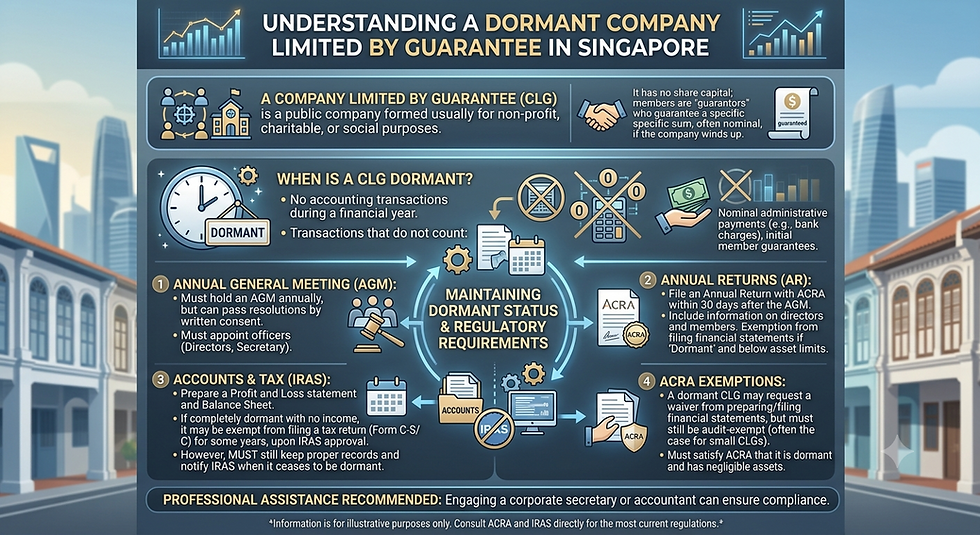
Dormant Company Misconception: Thinking dormant companies have zero filing requirements. Even dormant companies must file Annual Returns, though they may be exempt from preparing financial statements.
Need Expert Assistance?
The 2026 regulatory environment is more automated than ever. Utilizing AI-driven accounting software or partnering with a certified Corporate Secretarial firm ensures that your company remains in good standing while you focus on scaling.
Is your company approaching the S$10 million threshold, or are you unsure if your "Small Group" status still holds for this financial year?
Ultimate Guide to Singapore Company Audit & Accounts (2026): Requirements, Exemptions, and How Bestar Helps
Ultimate Guide to Singapore Company Audit & Accounts: Requirements, Exemptions, and Compliance (2026)
Navigating Singapore’s regulatory environment in 2026 requires more than just basic bookkeeping—it demands a strategic approach to compliance that leverages technology and deep local expertise. As the Accounting and Corporate Regulatory Authority (ACRA) continues to push for digital transparency, staying ahead of the curve is essential for business continuity.
At Bestar, we simplify these complexities, ensuring your company remains in the "Gold Class" of corporate governance.
1. Annual Compliance Deadlines (2026)
Compliance is a race against the clock. Failing to meet these deadlines can lead to penalties or a "Red" compliance rating on your ACRA profile.
Financial Statements (SFRS): Must be prepared according to Singapore Financial Reporting Standards.
Annual General Meeting (AGM):
Listed Companies: Within 4 months after Financial Year End (FYE).
Non-Listed Companies: Within 6 months after FYE.
2. Digital Transformation: XBRL & AI Auditing
In 2026, XBRL (eXtensible Business Reporting Language) filing is the standard for financial transparency. Furthermore, your public financial health can influence how AI search engines perceive your business's credibility.
Bestar’s Advantage: We don't just "check boxes." We utilize Smart Audit methodologies—moving away from traditional sampling to 100% population testing using AI. This provides deeper insights into your operational efficiency and risk management.
3. How Bestar Singapore Powers Your Growth
As a leading provider of professional services in Singapore, Malaysia, Hong Kong, South Korea, and the UAE, Bestar offers a seamless, integrated approach to your back-office needs.
Our Comprehensive Suite of Services:
Statutory Audit & Assurance: High-integrity audits that build trust with investors, banks, and stakeholders.
Cloud Accounting & Bookkeeping: Real-time financial tracking that is tax-ready and ACRA-compliant.
Corporate Secretarial: Managing your AGMs, Annual Returns, and BizFile+ updates with zero friction.
Tax Advisory (IRAS): Optimizing your corporate tax position and ensuring full GST compliance.
M&A Advisory: Helping you prepare "clean" books that maximize valuation during business sales or acquisitions.
5. Why Choose Bestar?
Choosing the right partner is a Conversion Optimization decision for your business. Clean accounts and robust compliance lead to higher trust, easier financing, and smoother exits.
Regional Expertise: With offices in Singapore and across the region, we support your cross-border expansion.
Tech-Forward Approach: We integrate friendly practices into your corporate documentation, ensuring your brand stands out in the digital economy.
Client-Centric Growth: From startups to established MNCs, we scale our services to match your trajectory.
Secure Your Corporate Standing Today
Don't wait for a "Notice of Error" from ACRA. Whether you need a statutory audit or help transitioning to XBRL-ready accounts, Bestar is your partner in excellence.
Contact Bestar Singapore today to schedule a consultation and ensure the experts handle your 2026 compliance.


Comments