
Maximizing Growth: A Guide to Reporting on Grants and Incentive Schemes in Singapore
- Roger Pay

- Jan 4
- 5 min read
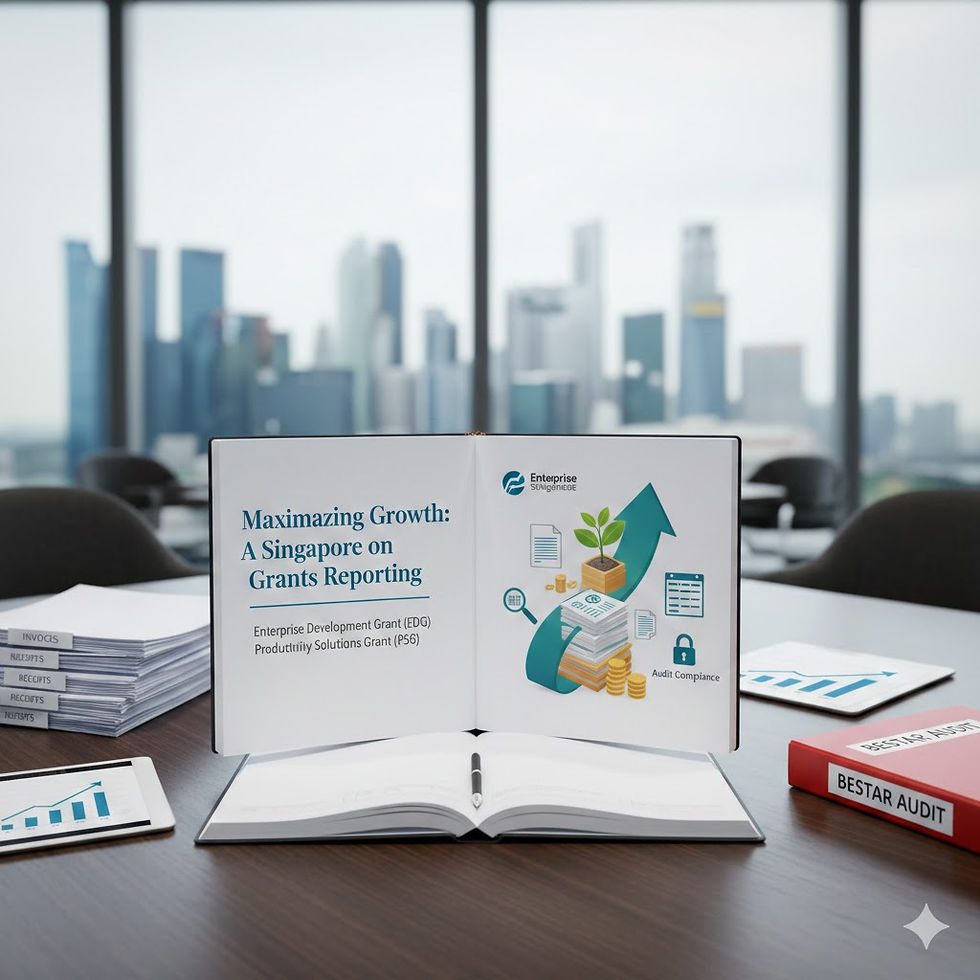
Reporting Singapore Grants and Incentives
Maximizing Growth: A Guide to Reporting on Grants and Incentive Schemes in Singapore
For Singapore-based businesses, securing a government grant—such as the Enterprise Development Grant (EDG) or the Productivity Solutions Grant (PSG)—is a major milestone. However, the work doesn't end when the letter of offer arrives.
Proper reporting and auditing are critical to ensuring the successful disbursement of funds and maintaining a clean compliance record with agencies like Enterprise Singapore (EnterpriseSG) and the Inland Revenue Authority of Singapore (IRAS).
Why Accurate Reporting Matters
In Singapore’s "Smart Nation" ecosystem, transparency is paramount. Accurate reporting on grant usage serves three primary purposes:
Fund Disbursement: Most Singaporean grants work on a reimbursement basis. You must prove the money was spent as intended before you receive the payout.
Audit Compliance: Large grants (typically those exceeding $100,000) require an independent audit by a public accountant.
Future Eligibility: A history of transparent reporting builds trust with government agencies, making it easier to secure future incentives.
Key Components of a Grant Report
While every incentive scheme has specific requirements, most reports in Singapore require the following documentation:
1. Proof of Project Completion
You must demonstrate that the "Project Deliverables" outlined in your initial proposal have been met. This might include:
Software screenshots or system go-live certificates.
New product prototypes or patent filings.
Training records and certificates for upskilled employees.
2. Financial Documentation
The government requires a clear paper trail for every dollar spent. Ensure you have:
Signed Contracts: Engagement letters with third-party consultants or vendors.
Invoices and Receipts: Must be itemized and match the project scope.
Proof of Payment: Bank statements or crossed cheque copies (cash payments are generally not eligible).
3. Impact and Outcome Metrics
Singaporean grants are focused on productivity and internationalization. You will often need to report on:
Quantitative KPIs: Revenue growth, man-hours saved, or increase in export sales.
Qualitative Benefits: Improved brand recognition or enhanced worker safety.
Common Challenges in Grant Reporting
Many SMEs face hurdles during the claims process. Staying ahead of these common issues can save weeks of delays:
Challenge | Solution |
Retrospective Claims | Ensure all costs were incurred after the grant approval date. |
Ineligible Costs | Avoid claiming for "business-as-usual" expenses like rent or basic utilities. |
Vendor Relatedness | Disclose if the vendor is a related party (e.g., owned by a family member) to avoid conflict of interest issues. |
Best Practices for a Seamless Payout
Maintain a Dedicated Folder: Start a digital repository the moment the project begins. Store every email, invoice, and bank slip related to the grant.
Standardize Internal Records: Use clear descriptions in your accounting software that mirror the line items in your Grant Letter of Offer.
Engage a Qualified Auditor Early: If your grant requires an external audit, engage a firm familiar with Singapore’s Grant Audit Framework early to avoid a last-minute rush.
Leveraging Tax Incentives
Beyond direct grants, don't forget to report on tax-based incentives like the Enterprise Innovation Scheme (EIS). Reporting for these typically happens during your annual Corporate Tax Filing (Form C-S/C), allowing for significant tax deductions or cash payouts for R&D and innovation activities.
Note: Always refer to the Business Grants Portal (BGP) for the most up-to-date submission templates and deadlines.
Navigating Grant Audits: Why Bestar is Singapore’s Trusted Choice for Grant Reporting
Maximizing Growth: A Guide to Reporting on Grants and Incentive Schemes in Singapore
In Singapore’s competitive business landscape, government grants like the Enterprise Development Grant (EDG) and the Market Readiness Assistance (MRA) grant are vital for scaling. However, the final hurdle—the grant claim—often requires a formal audit.
If your grant involves a significant disbursement, engaging a qualified auditor is not just a recommendation; it is a requirement. Bestar stands out as a leading public accounting firm in Singapore, specializing in navigating the complexities of the Singapore Grant Audit Framework.
The Role of a Public Accountant in Grant Claims
A public accountant serves as an independent verifier. When you submit a claim to agencies like Enterprise Singapore (EnterpriseSG), they need assurance that the funds were utilized strictly for the approved project scope.
Bestar provides this critical bridge between your business and the government. As a firm of qualified auditors, they ensure that your financial statements and project costs align with the strict guidelines set by Singaporean authorities.
Why Choose a Firm Familiar with Singapore’s Grant Audit Framework?
The Grant Audit Framework is a specific set of procedures and standards that auditors must follow. Working with a firm like Bestar offers several advantages:
Sector-Specific Knowledge: We understand what EnterpriseSG, ESG, and IMDA look for in a claim.
Accuracy in Reporting: We help identify "eligible" vs. "ineligible" costs, preventing claim rejections.
Efficient Turnaround: Familiarity with the Business Grants Portal (BGP) processes means faster audit reports and quicker fund disbursements.
Bestar’s Comprehensive Grant Audit Services
As a premier public accounting firm, Bestar offers specialized support tailored to the Singaporean ecosystem:
Service | Benefit to Your Business |
Independent Audit Certification | Required for EDG claims exceeding $100,000 to ensure compliance. |
Verification of Expenditures | Cross-checking invoices, bank statements, and contracts for accuracy. |
Compliance Advisory | Guidance on maintaining records that meet the Singapore Grant Audit Framework. |
Internal Controls Review | Strengthening your internal accounting to simplify future grant applications. |
Common Grants Requiring Audit Services
While many grants are available, those requiring a qualified auditor usually involve higher funding caps. Bestar assists businesses in auditing claims for:
Enterprise Development Grant (EDG): For projects involving core capabilities, innovation, and internationalization.
Market Readiness Assistance (MRA): For SMEs expanding their footprint into overseas markets.
Specialized Industry Grants: Including those for tourism, maritime, and sustainability sectors.
Why Bestar?
Choosing Bestar means partnering with a firm that balances professional rigor with a deep understanding of Singapore's SME landscape. Our status as a qualified auditor ensures that your grant reporting is handled with the highest level of integrity and technical competence.
By leveraging our expertise, you can focus on growing your business while we ensure your grant documentation is audit-ready and compliant with the latest regulatory changes.
List of Documents Bestar would typically require to begin a Grant Audit
The "Bestar Grant Audit Document Checklist" includes the essential items needed to begin the process, such as the Letter of Offer, financial records, proof of payment, and project deliverables.
Bestar Grant Audit Document Checklist
Letter of Offer (LOO) from the granting agency (e.g., EnterpriseSG)
Approved project proposal and budget breakdown
Signed vendor contracts and engagement letters
Itemized invoices and debit notes related to the project
Bank statements showing proof of payment (cleared cheques or FAST transfer records)
CPF contribution statements (if claiming manpower/salary costs)
Project completion report or proof of deliverables (e.g., screenshots, system reports)
Vendor's declaration of non-relatedness or disclosure of related parties
Latest ACRA Business Profile of the company


Comments