
Grant Advisory for Singapore Non-profits
- Roger Pay

- Jun 15
- 9 min read
Grant Advisory for Singapore Non-profits
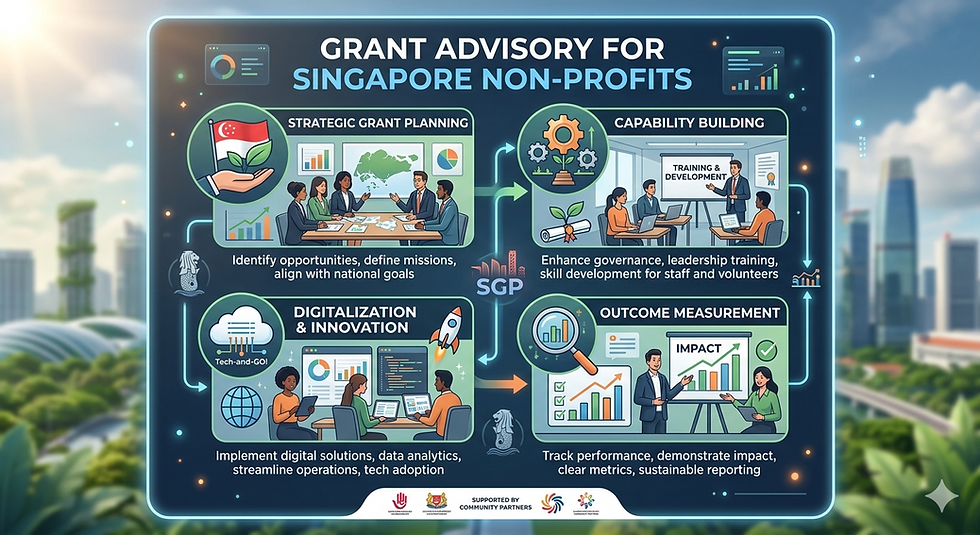
Navigating the non-profit funding landscape in Singapore requires a strategic blend of leveraging state-backed capability funds, tapping into centralized government portals, and aligning with philanthropic intermediaries.
Because Singapore utilizes a "Many Helping Hands" approach, funding is heavily structured around building long-term organizational capacity, digitalization, and clear outcome measurement.
Here is a practical advisory guide on the primary grant ecosystems and application strategies for Singaporean non-profits and Charities.
1. Core Government & Statutory Funding Ecosystem
Most public sector funding is consolidated through the OurSG Grants Portal (oursggrants.gov.sg), which acts as a one-stop shop for arts, community, heritage, youth, sports, and social good grants.
The Charities Capability Fund (CCF)
Administered via the National Council of Social Service (NCSS), the CCF is the most critical fund for enhancing operational efficiency, governance, and management capabilities of registered charities and Institutions of a Public Character (IPCs).
The CCF is structured into five distinct pillars:
CCF Training Grant: Co-funds up to 80% of course fees (subject to caps like $1,000 per course) to upgrade staff and volunteer skills.
CCF Consultancy Grant: Helps non-profits hire external specialists for strategic planning, financial management, or legal structures. Small/Medium charities can get up to 80% funding, capped at $100,000 over 5 years.
CCF Shared Services Grant: Covers up to 80% of costs (capped cumulatively at $30,000 per charity through March 2027) for outsourcing back-office operations like accounting, HR, and legal compliance.
CCF Info-Communications Technology (ICT) Grant: Often tied to the Tech-and-GO! initiative, it provides tiered funding (up to 80%, capped at $300,000 for large-scale IT projects over 3 years) for digital solution adoption and cyber security.
CCF Collaboration Grant: Supports partnerships between multiple non-profits to solve complex social issues collectively.
Tote Board Social Innovation & Program Grants
As one of Singapore’s largest non-profit funders, the Tote Board distributes proceeds from gaming surpluses to fund community healthcare, social innovation, and educational enrichment.
Focus: Strong emphasis on sustainability. Applications require comprehensive program logic models and robust outcome measurement frameworks showing how the project will survive after the grant ends.
Sector-Specific Line Ministries
MSF (Ministry of Social and Family Development): Primary funder for social services, typically funding 50% to 90% of approved operating costs for programs addressing disability, family services, and youth.
MCCY / National Arts Council / Sport Singapore: Target niche projects in community building, sports fitness, and cultural development through project-based and multi-year major grants.
2. Structural & Strategic Requirements
To successfully unlock these grants, non-profits must satisfy rigorous compliance indicators:
IPC Status Advantage: While standard Charity or Society registration is the baseline, holding Institution of a Public Character (IPC) status significantly raises governance credibility and opens doors to higher-tier institutional funding and dollar-for-dollar donation matching schemes (e.g., the Community Silver Trust for the eldercare sector).
The Procurement Rule (Three Quotations): For any consultancy, shared services, or ICT grant application exceeding $6,000, charities are strictly required to attach three independent quotations of comparable scope. Funding is universally awarded based on the lowest comparable quote.
Lead-Time Planning: Grant applications for consultancy and shared services must be submitted via the OurSG Portal 2 to 3 months before the project or service commences. Retroactive funding is highly rare.
3. Emerging Philanthropic & Advisory Intermediaries
Beyond state grants, Singapore's ecosystem is rapidly shifting toward structured, evidence-based philanthropic capital driven by the influx of family offices and regional foundations. Non-profits looking for alternative funding models should engage with these key intermediaries:
Temasek Trust Foundation Advisors (TTFA): Provides non-profits with tailored advisory services spanning strategic planning, donor match-making, and specialized grant-making support to expand institutional reach.
Donor-Advised Funds (DAFs) & Networks: Platforms like the Community Foundation of Singapore (CFS), Asia Community Foundation, and the Philanthropy Asia Alliance act as aggregators. They match high-net-worth donor portfolios with vetted non-profits that demonstrate clear, research-backed community impacts.
Next Steps for Action
When advising or preparing a non-profit for a grant cycle, it is best to audit its current compliance stance against the funding criteria first.
Comprehensive Checklist of Documentation, Board Resolutions, and Financial Metrics required to Apply for the Singapore Charities Capability Fund (CCF) grants
Applying for the Charities Capability Fund (CCF)—whether for Consultancy, Shared Services, or ICT/Digitalization—requires specific documentation and corporate compliance indicators. The National Council of Social Service (NCSS) enforces strict vetting protocols to ensure public funds are directed to well-governed organizations.
Below is a comprehensive pre-submission checklist grouped into structural documentation, board alignment requirements, and financial metrics.
1. Compliance & Statutory Documentation Checklist
Before drafting a project proposal on the OurSG Grants Portal (OSG), ensure your organization's records on the Charity Portal (charities.gov.sg) are completely up to date. Vetting officers verify these baseline filings before reviewing the grant application.
[ ] Latest Annual Report: The most recently concluded financial year's annual report, detailing program updates and key activities.
[ ] Audited Financial Statements: Signed copies of your audited financial statements for the last financial year (or the last 3 financial years if your charity is newly seeking larger grant brackets).
[ ] Governance Evaluation Checklist (GEC): Your submitted GEC via the Charity Portal reflects your compliance score with the Code of Governance for Charities and IPCs.
[ ] The Three-Quotation Procurement Rule (For Projects > $6,000):
[ ] Three Independent Quotations: Must be of comparable scope from separate vendors.
[ ] Evaluation Summary: A brief write-up justifying why you chose your preferred vendor. If you do not choose the lowest bid, a highly robust, objective technical justification must be attached.
[ ] Note: For projects under $6,000, a single quotation from your preferred vendor suffices.
[ ] Vendor Proposal/Scope of Work: A detailed technical or advisory roadmap provided by the vendor, mapping out key deliverables, timelines, and milestones.
2. Board Resolution Framework
NCSS requires proof that the charity’s leadership has officially sanctioned the capability project and understands the co-funding responsibilities.
A formal Board Resolution or an extract of Board Meeting Minutes signed by the Chairman, Secretary, or authorized Board Members must be attached to the application.
The resolution should explicitly state:
[ ] Project Approval: Formal acknowledgment and approval of the specific project scope (e.g., "Approval to engage XYZ Pte Ltd to implement an automated cloud-based accounting system under the CCF Shared Services Grant").
[ ] Budget & Co-funding Committal: Explicit mention of the total estimated project cost and a formal commitment that the charity will self-fund the remaining co-payment balance (typically 20% of the project value for small/medium charities).
[ ] Authorized Signatories: A designation of specific personnel (usually the Executive Director, Managing Director, or a Board Treasurer) authorized to sign the CCF Funding Agreement with NCSS and submit claims via CorpPass.
3. Financial Metrics & Tiering Criteria
Your charity’s financial size dictates the funding caps and subsidy percentages you qualify for. NCSS prioritizes small-to-medium enterprises within the non-profit sector.
Assessing Your Charity's Tier
Review your latest financial statements to confirm your organization's position against these metrics:
Metric / Indicator | Small Charity | Medium Charity | Large Charity |
Gross Annual Receipts | Less than $250,000 | $250,000 to $10 Million | Greater than $10 Million |
Audit Requirement | Statements can be verified by an independent reviewer if receipts are under $500k. | Full statutory audit by a Public Accountant is mandatory. | Full statutory audit by a Public Accountant is mandatory. |
Typical CCF Subsidy Quantum | Up to 80% co-funding | Up to 80% co-funding | Tiered or reduced funding caps apply depending on the grant component. |
Critical Financial Rules for CCF Claims
[ ] Liquid Reserves / Co-payment Capability: Evaluators assess whether your charity has sufficient unrestricted liquid funds to pay the vendor upfront. The initial 30% to 50% of the grant is disbursed upon signing the agreement, but the remaining balance operates on a reimbursement basis post-milestone evaluation.
[ ] Cumulative Funding Caps Tracking: Ensure your application does not breach the cumulative caps designated for the current funding cycle (e.g., the $30,000 cumulative cap per charity for Shared Services running through March 31, 2027).
⚠️ Critical Risk Warning: Never sign a commercial engagement letter, contract, or make an advance payment to a vendor before receiving your formal CCF Letter of Award. Retroactive funding is strictly forbidden; any project that commences before official NCSS approval will be disqualified from receiving subsidies.
How Bestar Singapore Can Help
Navigating Singapore’s non-profit and social service ecosystem requires a strategic pivot away from short-term "survival" funding and toward sustainable institutional growth. To successfully unlock major state funds like the Charities Capability Fund (CCF) or secure multi-year commitments from philanthropic networks, non-profits must master three operational pillars: building long-term organizational capacity, executing deep digitalization, and implementing clear outcome measurement.
As an established, multi-disciplinary Public Accounting Corporation and Registered Filing Agent in Singapore, Bestar acts as your outsourced corporate co-pilot. We bridge the gap between compliance requirements and strategic growth, enabling your non-profit to scale its social impact securely.
Here is a comprehensive breakdown of how Bestar maps its professional services directly to the core transformation needs of modern Singaporean charities.
1. Building Long-Term Organizational Capacity
True capacity building means strengthening your non-profit’s internal infrastructure so it can survive leadership transitions, economic shifts, and rigorous regulatory scrutiny. NCSS heavily weights structural resilience when awarding major capability grants.
       [ STRATEGIC GOVERNANCE ]  --> Managed by Bestar Corporate Desk
                 │
                 ▼
       [ OPERATIONAL CAPACITY ]  --> Supported by Bestar HR & Shared Services
                 │
                 ▼
     [ COMPLIANCE RESILIENCE ]   --> Secured via Bestar Statutory Oversight
Strategic Governance & Secretarial Advisory
Led by our corporate secretarial team, Bestar ensures your organization maintains impeccable standing under the Singapore Charities Act and ACRA regulations.
Board Competency & Board Resolutions: We assist in structuring complex corporate records, drafting compliant board resolutions for grant applications, and managing your Governance Evaluation Checklist (GEC) filings to uphold the Code of Corporate Governance for Charities and IPCs.
Vetting Intermediary Management: Bestar prepares your entity to confidently interface with institutional funders, regional family offices, and specialized aggregators like the Community Foundation of Singapore (CFS).
Scalable Back-Office Outsourcing (Shared Services)
Smaller charities often struggle with administrative overhead, pulling vital resources away from their core mission. Bestar solves this through our structured corporate desks:
Cross-Border Payroll & HR Advisory: Guided by our People Advisory Director, Emily Chow, Bestar delivers robust payroll outsourcing, employment pass administration, and performance framework designs to foster a high-performance volunteer and staff culture.
Grant Optimization: We structure your outsourced engagements to help you tap into the CCF Shared Services Grant, which covers up to 80% of outsourced expenses (capped cumulatively at $30,000 through March 31, 2027).
2. Accelerating Digitalization (Tech-and-GO!)
Legacy manual workflows leave non-profits vulnerable to data loss, compliance lapses, and administrative bottlenecks. Modern funding panels prioritize tech-enabled charities that optimize donor dollars through automation.
Cloud Financial Infrastructure
As an advanced Xero Partner, Bestar transitions non-profits from traditional spreadsheets to automated, cloud-based financial ecosystems.
Real-Time Data Access: Centralize your general ledgers, accounts payable, and restricted fund tracking on a secure, web-based platform accessible by your board anytime, anywhere.
Seamless Integration: We deploy digital accounting architecture that integrates smoothly with standard non-profit donor management systems and payment gateways, removing manual data-entry risks.
Cybersecurity & Digital Tax Compliance
Cyber Hygiene Adherence: Digital transformation expands your data footprint. Bestar ensures your digital framework adheres to fundamental data safety standards, safeguarding private donor profiles and financial records.
IRAS & GST Digital Filings: We manage your statutory tax planning and digital GST compilation, ensuring seamless submissions that align with current electronic filing frameworks.
3. Implementing Clear Outcome Measurement
In Singapore's social sector, donors and statutory bodies no longer fund activities based solely on "good intentions"—they fund verifiable outcomes. Transitioning your financial model to support transparent outcome tracking is essential.
  Traditional Model:  [ INPUTS: Funds ]  ──>  [ OUTPUTS: Activities Run ]
                                                      │
                                                      ▼ (The Bestar Shift)
  Impact-Driven:      [ OUTCOMES: Clear, Audit-Verified Social Change ]
Fund Accounting & Financial Transparency
To prove how efficiently funds are translated into social change, charities must maintain immaculate financial clarity between unrestricted public donations and restricted program grants.
Segmented Fund Accounting: Bestar sets up customized chart of accounts tracking. This ensures every dollar linked to a specific program or government grant is traceable down to the specific transaction line, providing clear audit trails for grant acquittal.
SMART Audit Methodology: As a licensed Public Accounting Corporation, Bestar offers accelerated statutory audit lifecycles. By leveraging advanced data analytics to assess data flows rather than relying on slow manual sampling, we provide ACRA-ready Audited Financial Statements rapidly, ensuring you never miss a grant submission deadline.
M&A, Restructuring, and Aggregation Advisory
As social problems grow more complex, single charities often look to pool resources. Bestar provides specialized corporate restructuring, joint-venture framework creation, and financial due diligence to assist charities executing collaborative sector initiatives under the CCF Collaboration Grant.
Why Partner with Bestar?
What truly sets Bestar apart is our integrated, multi-disciplinary model. Rather than forcing your non-profit to coordinate between separate corporate secretarial firms, distinct IT vendors, and independent public accountants, Bestar houses all these capabilities under a single roof.
Your dedicated Bestar Account Manager coordinates directly with our internal auditors, tax advisors, corporate secretaries, and cloud specialists—eliminating communication gaps and ensuring your organization remains perpetually "investor and grant-ready."
Secure Your Non-Profit's Infrastructure Today
Transform your mandatory compliance requirements into a resilient foundation for long-term social impact. Contact our advisory specialists to schedule a governance and capability consultation.
Email: admin@bestar-asia.com
Phone: +65 6299 4730
Address: Bestar, 23 New Industrial Road, #04-08 Solstice Business Center, Singapore 536209


Wait, did they really say we need three quotes for anything over $6,000 on this sig fig calculator-style strict portal? It’s wild how the main significant figures calculator homepage sets such rigid rules for our grants.